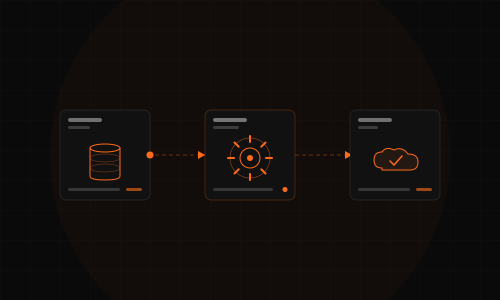
- Customers pay online
- Invoices send themselves
- Replies drafted for your review
Custom software and AI agents
Exports, reminders, follow-ups by hand? We build the tool that runs them for you.
Less busywork, more sales: every tool we build starts from a pain like these. Your software live in under a month, secured by an engineer, in your own accounts.
Sound familiar?
The six calls we get most
Most projects here start from one of these. If one of them is yours, the first conversation is short.
Book a 15-minute callWhat we build
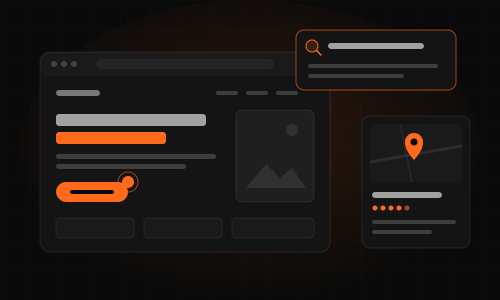
Three services, one aim: an app that runs your business, an AI agent that does the repeat work, or a website that makes you visible.

Problems we took on
Each one started somewhere specific. So does yours.
No surprises on price, scope or deadline.
A fixed price for the scope, agreed before any code. Every change reviewed and tested by an engineer before it goes live.
- 01
Discovery call
Fifteen minutes on your business and what it costs you today. You leave knowing whether we are the right people, even when the answer is no.
- 02
Spec
Screens and user stories written UX-first, priced as a fixed scope. You approve it before a single line of code is written.
- 03
Build
Spec-driven and agent-assisted, with every change reviewed and tested by a person. A working demo at the end of each sprint.
- 04
Delivery and support
In production, in your accounts, documented and handed over. Then we monitor it, fix what breaks and keep improving it.
You're not locked in
If we part ways tomorrow, you keep everything, and another team can pick it up the next day.
The code is yours
Every repository, in your account, from the first commit. Not a copy handed over at the end.
So is everything around it
Architecture decisions, documentation, credentials. What we know about your system is written down, not carried in someone's head.
Your data stays in your accounts
The database, its backups and the hosting are opened in your name. We work inside them; we never hold them.
Support is optional
Keep us on for maintenance if it helps. Any competent team can take over from the code and the docs.
What clients say
… Je n’ai jamais rencontré Anthony, personne me l’a recommandé, mais dès notre premier échange, j’ai su que j’avais affaire à un grand professionnel.
Hans Raharijaona
CEO · MIS’AINA
… Il possède une réelle autonomie, communique de manière claire et transparente, et sait faire avancer les sujets sans jamais perdre de vue les priorités de l’équipe. …
Romain Berezay
Co-founder · SoWell
Très satisfaite de ma collaboration avec Mr Mizael, dans la hâte j’ai cherché quelqu’un qui pourra répondre vite et parfaitement à mes exigences, et il a su le faire. …
Ravaka Malala
Executive Assistant, AI Operations Specialist
The questions that come before the call
Eight answers before you call.
We hired a developer before and it went badly. Why would this go differently?
Because you see the software running every week from the start, so a bad fit shows itself while most of the budget is still unspent. The repositories are in your account from the first commit, and the written scope is yours to keep whether or not you go ahead. Nothing here asks you to trust MAMYCODE before there is something to look at.
What if you build the wrong thing?
Then you find out in a week rather than at delivery. MAMYCODE ships in short iterations and puts each one in front of the people who will actually use it, so a wrong assumption gets corrected while correcting it is still cheap. The written scope is a starting point, not a contract that forces a bad build to completion.
Is our company too small for custom software?
The question is usually the wrong way round: what decides it is whether one process costs you enough hours to be worth automating, not how many people you employ. MAMYCODE will say plainly when an off-the-shelf tool is the better trade. Of the three services, an AI agent on one repeat task is the least expensive to start, and it is where a small team usually finds the clearest return.
Can you take over an app built with Lovable, Bolt, Cursor or v0?
Yes, and it is a common starting point. MAMYCODE reads what is there first, fixes what is risky (authentication, exposed keys, missing tests, a deployment nobody can repeat), and then keeps building on it rather than starting over. The same goes for code a previous developer left behind.
We do not know exactly what we want yet. Is it too early to talk?
No, that is the normal starting point. Working out what should be built is the first part of the work rather than something to finish before it starts, so MAMYCODE asks questions on a fifteen-minute call and turns the answers into a written scope. No specification is needed and no preparation either.
How do we know a small team can handle something this important?
You look at the work before you commit to it. MAMYCODE publishes its case studies, and the first weeks of any build put running software in front of you rather than a progress report. The team is small on purpose: the engineer on the call leads the build and writes the code, with no layer in between.
How long does it take to build our software?
Under a month for the scope agreed in your spec. AI agents write the routine code, an engineer reviews and tests every change, and you see a working build at the end of each sprint. After launch, the product keeps growing from how people actually use it.
We're in different time zones. How does working together work?
Calls happen in English or French, in your working day: European hours, and US mornings. You get a written spec before any code, access to the repository and a staging link from the first week, and a demo at the end of every sprint. Contracts are with MAMYCODE LLC, a US company registered in Missouri.
Ready to get the hours back, or the product out?
Every week it waits, your team loses those hours again. In 15 minutes you'll know if it's feasible and what the first step would cost, with a written recap either way.